Designing an musical educational software combining traditional music-pedagogical methods and emerging technologies: The case of Synth4Kids
2022

Design and development of the original music educational software Synth4kids and integration in the “Music Theory” course of the conservatoire education in Greece
The doctoral dissertation was completed at European University Cyprus in 2023. This page presents the design of Synth4kids, the research aims and methodology, the educational intervention and its findings. It also includes the committees, photographs, related publications and access to the thesis.

School of Humanities and Social Sciences
PhD in Music Education2023
The technological developments of recent years are constantly redefining the ways in which people come into contact with music, shaping new perspectives of musical expression, interaction, and learning. Children grow up in an environment broadening their musical experiences and preferences. In this context, musical praxis acquires new meanings through the use of digital media, creating, at the same time, challenges for music education. These rapid developments have led to the design of digital learning environments and educational software, emerging an instructional framework radically different from the conventional one. However, in Greece, conservatoire settings do not seem to align with the digital educational context and current trends in the “music, education, technology,” emphasizing teaching models designed decades ago without including emerging technologies. The purpose of this research was the analysis of the design and development of the original musical educational software Synth4kids and its evaluation through the description and understanding of the experiences of a group of four children aged six and seven years in the “Theory of Music” course in a conservatoire setting in Athens. The ultimate goal was to examine the music teaching-learning processes when technological pedagogical actions are developed in the specific lesson with the digital tool Synth4kids.
Regarding Synth4kids, the research focused on educational software design issues based on learning and instructional design theories, traditional music pedagogical methods, current trends in music education, and participants’ viewpoints. Synth4kids consists of a representation of a virtual musical instrument with enhanced and augmented capabilities oriented to lessons. The design was based on a constructivist and constructionist approach. It draws practices from traditional music education methods, emphasizing chromaesthesia, the pentatonic scale, the movable-do technique, graphic score design, and kinaesthetic experiences. In addition, it reflects elements from emerging technologies –augmented reality, connection with tangible interfaces, musical performance with eye-tracking and face-tracking, use of QR-Code, online collaborative practices via WebRTC– offering new possibilities for musical experimentation and opportunities for extended forms of musical interaction, creation, and learning.
Apart from the design and development of Synth4kids, this thesis focuses on the results of an educational intervention in the first year of the “Theory of Music” course in a Greek conservatoire, where maker movement scenarios were designed and implemented, utilizing Synth4kids. The ultimate goal was to explore the learning processes by examining children’s perceptions of the value of the experience for their musical understanding and the acquisition of musical and technological knowledge and skills. The qualitative tools of participatory observation, focus group interviews, informal discussions with the children, written formative assessments, non-participatory observation by an external observer, and log-tracking data of the software were implemented to collect the data. The findings revealed that the participants adapted to the new musical-technological learning environment and showed a strong interest in participating in the procedures. They appeared to be absorbed in problem-solving in authentic music teaching-learning situations and expressed enthusiasm to experiment, reflect and create. Overall, it is shown that the new learning environment enhanced skills –creativity, computational thinking, music theory knowledge, and skills from STEAM fields– and gained meaningful experiences.
The research examines the design and development of Synth4kids and its use in a conservatoire Music Theory course.
The study describes and analyses the children’s experiences during the educational intervention. Data collection included participant observation, focus group interviews, informal discussions with the children and written formative assessments.
It also used non-participant observation by an external observer and software logs of users’ actions. The data concerned participation, learning processes and the meanings children attached to their experiences.
Maria Papazachariou-Christoforou
Assistant Professor of Music Education, European University Cyprus
Smaragda Chrysostomou
Professor of Music Education, National and Kapodistrian University of Athens
Maria Meletiou-Mavrotheris
Professor of Mathematics Education, European University Cyprus
Loucas Louca
Associate Professor of Science Education, European University Cyprus
Angeliki Triantafyllaki
Associate Professor of Music Education, University of Ioannina
Marios Vryonides
Vice Rector for Research and Professor of Sociology of Education, European University Cyprus
The software represents a virtual musical instrument with capabilities designed for music teaching. Its design connects constructivist and constructionist approaches with practices such as chromaesthesia, the pentatonic scale, movable-do, graphic scores and kinaesthetic experiences.
It includes augmented reality, connections to tangible interfaces, eye-tracking and face-tracking control, QR codes and online musical collaboration through WebRTC.
In this group of children, the study recorded an interest in participation, experimentation and engagement in musical problem-solving. The analysis connected these experiences with creativity, computational thinking, music theory knowledge and skills from STEAM fields.
The intervention took place in the first year of a Music Theory course at a conservatoire in Athens, with four children aged six and seven. Maker movement teaching scenarios were designed and implemented using Synth4kids, giving the children opportunities to experiment, create and solve musical problems.
The photographs below document the educational intervention.
This research journey benefited from the cooperation and conversations of colleagues, collaborators and friends, whose contributions offered valuable opportunities for reflection and inspiration. I am especially grateful to my supervisor, Maria Papazachariou-Christoforou, for her support, encouragement and guidance throughout my doctoral studies. I also warmly thank the other members of my supervisory committee, Smaragda Chrysostomou and Maria Meletiou-Mavrotheris, for their constructive discussions, comments and advice. Their contributions were invaluable in addressing the difficulties and challenges of the research.
I also thank my friend and collaborator Dr May Kokkidou for inspiring my thinking about the design of Synth4kids, and for her advice, constructive discussions and encouragement to begin and continue the research. I am grateful to my parents for the support, help and encouragement that made this work possible.
I acknowledge the essential contribution of the children and their parents, whose participation made the study possible. Finally, I warmly thank all the friends and collaborators who supported this project and encouraged me throughout the research journey.
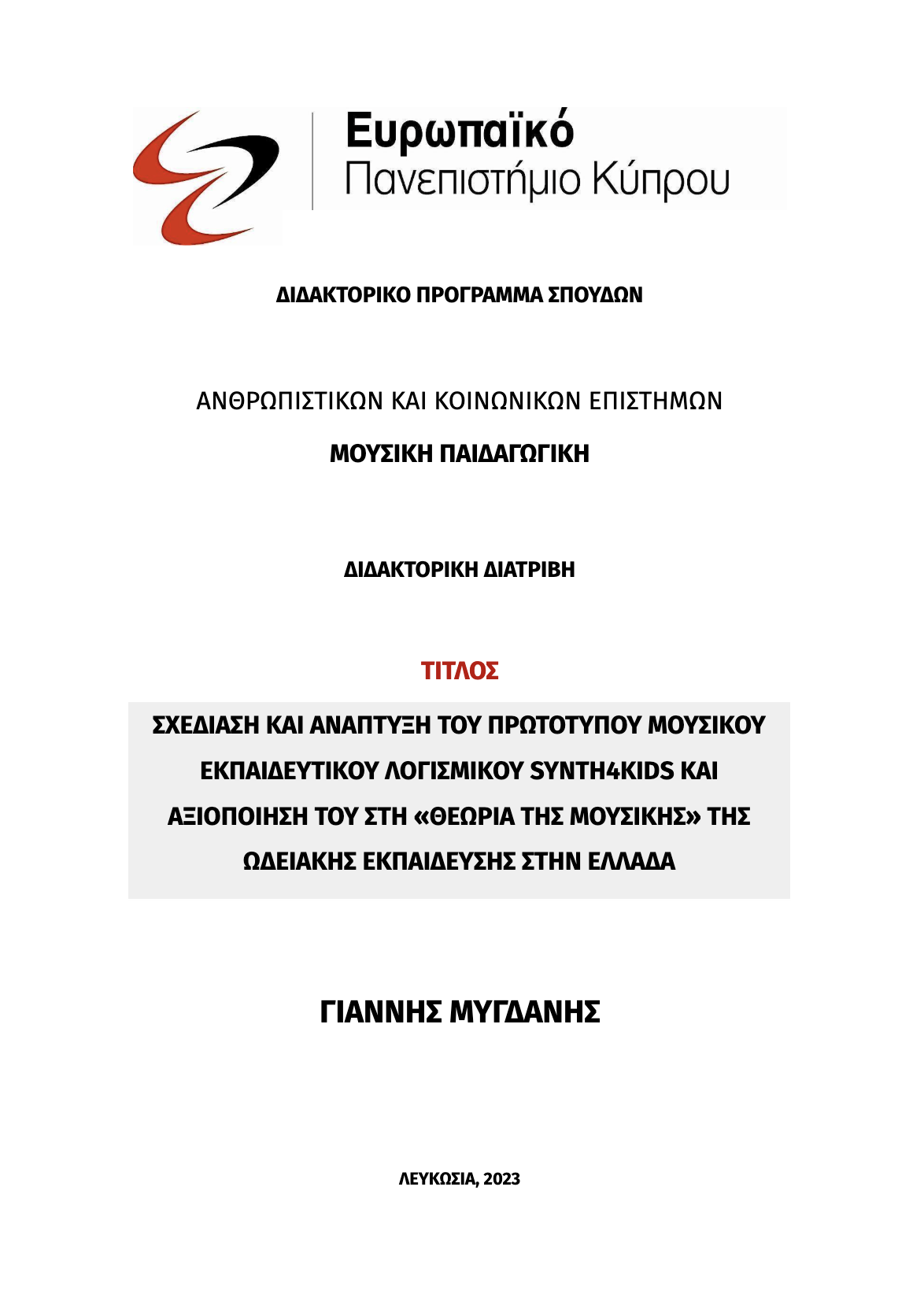
Mygdanis, Y. (2023). Design and development of the original music educational software Synth4kids and integration in the “Music Theory” course of the conservatoire education in Greece [Doctoral dissertation, European University Cyprus]. National Archive of PhD Theses. https://doi.org/10.12681/eadd/54483
Full text ↗ Second repository ↗2022
2018
2018
2018
2018
2017