

Synth4kids
Soundscape creation & music production
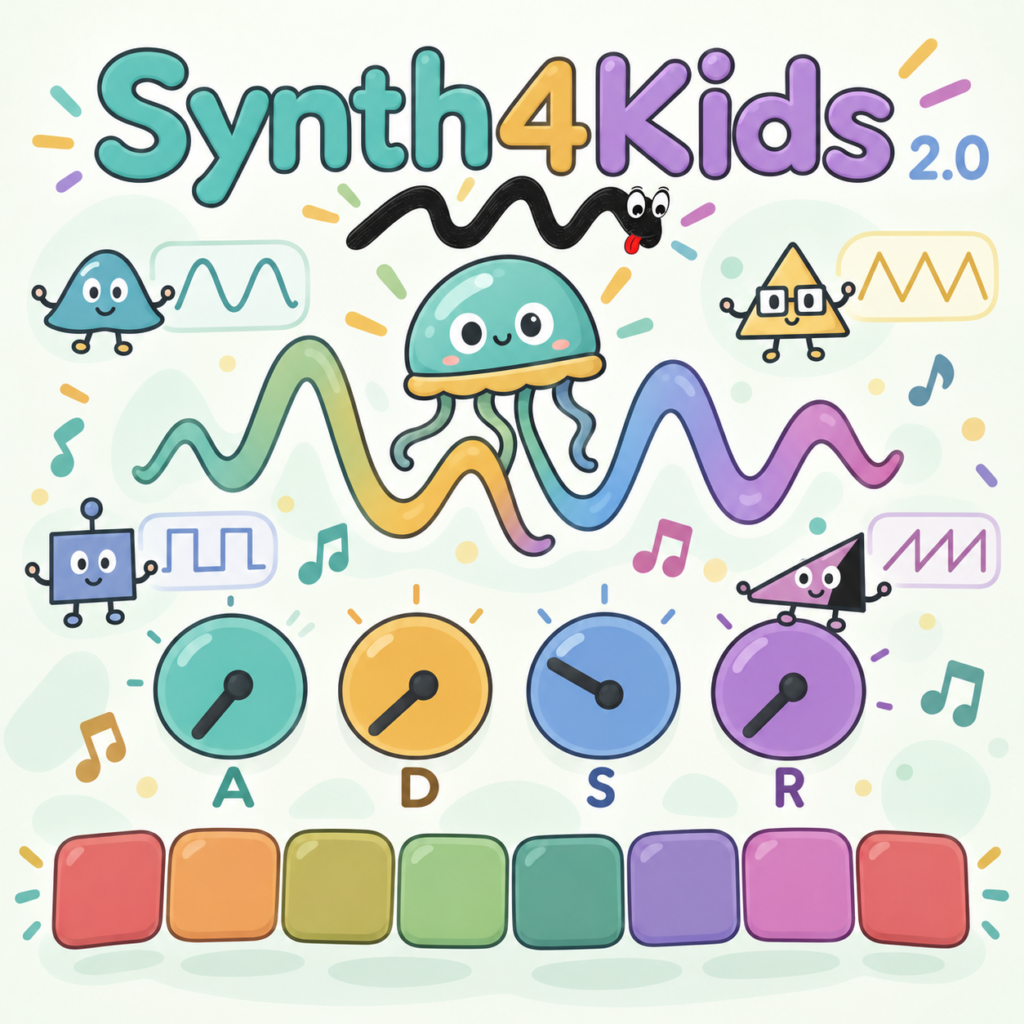
Synth4kids is a web synthesiser for exploring sound, composing and improvising. Play a short melody and repeat it with a different timbre. Listen to how the character of the sound changes while the notes and rhythm stay the same.
The pentatonic scale and musical ribbon give children different ways to explore pitch and how it moves. In early childhood education and conservatoire music theory, the application has been used in listening, performance and composition activities, from graphic notation and movable do to making tangible musical interfaces.
Sources
In the doctoral study on Synth4kids, four children aged six and seven used the software in a music theory class at a conservatoire in Athens. Over fifteen sessions, STEAM activities combined the virtual instrument with hands-on making and tangible interfaces such as Makey Makey.
Christina Charalambidou and Yannis Mygdanis studied the use of the instrument with children aged four to six in preschool and early primary education. The public lecture at European University Cyprus connects these examples with work in special education, primary schools and conservatoires.
In Cyprus, Synth4kids is also used in a primary-school blues project. C Blues Jam Keys! was developed for the same project in collaboration with the Ministry of Education, Sport and Youth. Project background.
Use in independent research
Lizou, M. A. (2020). Enhancing creativity in primary school music lessons [Master’s thesis, University of Ioannina]. In this second-grade pilot programme, groups of children used Synth4kids to compose and invent ways to write down their musical ideas.
Related publications and presentations
Journal articles, chapters in edited volumes, papers in conference proceedings and published teaching scenarios by Yannis Mygdanis. Each record provides bibliographic details and an abstract, with links to the publisher, DOI or full text where available. Browse by type or year, search the catalogue and switch between title and APA reference views.
12 results
Chapters in edited volumes
Empowering inclusive and multimodal practices in preschool music education: Exploring the assistive technology potential of Synth4kids software
In K. Mavrou & P. Encarnação (Eds.), Technology for inclusion and participation for all: Recent achievements and future directions (pp. 429–436). Springer.
Mygdanis, Y., & Charalambidou, C. (2025). Empowering inclusive and multimodal practices in preschool music education: Exploring the assistive technology potential of Synth4kids software. In K. Mavrou & P. Encarnação (Eds.), Technology for inclusion and participation for all: Recent achievements and future directions (pp. 429–436). Springer.
Mygdanis, Y., & Charalambidou, C. (2025). Empowering inclusive and multimodal practices in preschool music education: Exploring the assistive technology potential of Synth4kids software. In K. Mavrou & P. Encarnação (Eds.), Technology for inclusion and participation for all: Recent achievements and future directions (pp. 429–436). Springer. https://doi.org/10.1007/978-3-032-01628-7_51
Abstract
This study examines the design and implementation of educational scenarios created with Synth4kids, an innovative music-educational software designed for preschool education. Synth4kids offers an intuitive environment that fosters musical creativity, inclusion, and differentiated instruction through emerging and assistive capabilities. As an original and innovative tool designed for preschool education, it bridges accessibility gaps while promoting joyful, multisensory music-making. The intervention consisted of twelve weekly sessions, each lasting approximately 45 min, for four male children aged four to six years, at Baby Maestro Cyprus. Sessions were structured to integrate the AT and ET features of Synth4kids. In line with Universal Design for Learning principles, educational activities have been crafted to boost musical engagement in young children via personalized, play-based interactive experiences. The findings indicate that the early integration of assistive features, such as gaze control, motion tracking, tactile interfaces, and chromesthesia, significantly enhances accessibility, creativity, and social participation among learners with diverse profiles. Notably, incorporating Synth4kids into music teaching and learning activities demonstrates how AT tools promote agency, autonomy, and collaborative creativity, fostering new pedagogical approaches that enhance equity and engagement in music education. Overall, this study reveals that the thoughtful use of digital technologies can transform early childhood music education into an inclusive and dynamic learning environment.
Synth4kids: An analog synthesizer web-application for music teaching-learning
In T. Shopova & G. Apostolova (Eds.), The digital revolution in the cultural and social processes (pp. 229–240). University Publishing House “Neofit Rilski”.
Mygdanis, Y. (2018). Synth4kids: An analog synthesizer web-application for music teaching-learning. In T. Shopova & G. Apostolova (Eds.), The digital revolution in the cultural and social processes (pp. 229–240). University Publishing House “Neofit Rilski”.
Mygdanis, Y. (2018). Synth4kids: An analog synthesizer web-application for music teaching-learning. In T. Shopova & G. Apostolova (Eds.), The digital revolution in the cultural and social processes (pp. 229–240). University Publishing House “Neofit Rilski”.
Abstract
Nowadays, children grow up in a digital-cultural environment that forms their music experiences. However, traditional music-educational methods, designed many decades ago, do not involve new technologies or the use of electronic sounds and instruments in their content. In this respect, a vital part of children's music preferences is not expressed. In recent years, as an attempt to integrate digital media into early musical lessons, some virtual instruments have been developed. However, most of them consist of reproductions of acoustic instruments (pianos, glockenspiels, percussion) without taking advantage of the expanded capabilities of new technologies. This paper aims to present Synth4kids, an original music-making web-application created for children aged 5 to 8 years. Synth4kids is a monophonic virtual instrument synthesizer based on analog synthesis, incorporating elements from the traditional music-educational methods, oriented toward music lessons. It is also compatible with all tablets and computers and can be used alone or in conjunction with acoustic and Orff instruments. Furthermore, it benefits from the tablets' tilt sensor and touch screen, enabling extended kinaesthetic experiences. All in all, it offers opportunities for extended sound experimentation and improvisation, allowing children to get in touch with electronic music.
Articles in scientific journals
Integrating current technologies into pre-school music teaching–learning: A practical intervention utilizing the educational music software Synth4kids with children aged 4–6
International Journal of Music in Early Childhood, 20(2), 177–200.
Charalambidou, C., & Mygdanis, Y. (2025). Integrating current technologies into pre-school music teaching–learning: A practical intervention utilizing the educational music software Synth4kids with children aged 4–6. International Journal of Music in Early Childhood, 20(2), 177–200.
Charalambidou, C., & Mygdanis, Y. (2025). Integrating current technologies into pre-school music teaching–learning: A practical intervention utilizing the educational music software Synth4kids with children aged 4–6. International Journal of Music in Early Childhood, 20(2), 177–200. https://doi.org/10.1386/ijmec_00085_1
Abstract
In recent years, rapid technological advancements have transformed the ways people interact with music. Children of the digital era are immersed in environments that expand both their musical experiences and preferences. The emergence of digital technology has paved the way for the creation of learning environments and software tailored to young children’s education. These tools aim to establish a new educational framework that is distinct from traditional approaches. However, music education does not seem to align with this new digital educational context, as it continues to emphasize instructional models developed decades ago – models that typically exclude the use of digital technologies in their content. This article presents the findings of an educational intervention designed to integrate and utilize digital media in pre-school and early primary music education, utilizing the music educational software Synth4kids. The research results demonstrate the creation of a new technology-enhanced learning environment where children found meaning and participated actively and enthusiastically in authentic music teaching and learning situations, transforming their experiences and acquiring new musical and technological skills.
Designing and applying educational scenarios using Synth4Kids musical educational software in preschool education
International Journal on Integrating Technology in Education, 13(3), 65–76.
Charalambidou, C., & Mygdanis, Y. (2024). Designing and applying educational scenarios using Synth4Kids musical educational software in preschool education. International Journal on Integrating Technology in Education, 13(3), 65–76.
Charalambidou, C., & Mygdanis, Y. (2024). Designing and applying educational scenarios using Synth4Kids musical educational software in preschool education. International Journal on Integrating Technology in Education, 13(3), 65–76. https://doi.org/10.5121/ijite.2024.13305
Abstract
The rapid technological advancement of recent years has transformed how people interact with music. In a world where digital transformation is accelerating, the role of technology in music education has become increasingly crucial. In particular, digital platforms and tools are reshaping the way music is taught, especially for younger generations. Children in the digital age are exposed to various musical experiences and preferences. This has led to the development of digital learning environments and software for preschool children, creating a fundamentally new educational framework. However, music pedagogy often relies on traditional teaching models that do not incorporate digital technologies. This article discusses findings from an educational intervention using the Synth4kids software in early childhood music education. Synth4kids offers new avenues for educators to incorporate technology into early childhood education, encouraging creativity, collaboration, and engagement. The study highlights how combining technology and music pedagogy can enrich the learning experience for young children. The results highlight a new techno-centric learning environment where children engage actively and enthusiastically in authentic music teaching and learning situations, transforming their experiences and developing new musical and technological skills. Additionally, the study shows the importance of designing child-friendly software that balances educational goals with playful engagement.
Exploring the integration of maker culture activities in the theory of music course at a Greek conservatoire
Journal of Music, Technology & Education, 16(1–2), 99–118.
Mygdanis, Y., & Papazachariou-Christoforou, M. (2023). Exploring the integration of maker culture activities in the theory of music course at a Greek conservatoire. Journal of Music, Technology & Education, 16(1–2), 99–118.
Mygdanis, Y., & Papazachariou-Christoforou, M. (2023). Exploring the integration of maker culture activities in the theory of music course at a Greek conservatoire. Journal of Music, Technology & Education, 16(1–2), 99–118. https://doi.org/10.1386/jmte_00062_1
Abstract
In the past decade, there has been a significant effort to incorporate maker culture principles and techniques into education. By following the STEAM education perspective, integrating maker movement educational scenarios presents an opportunity to establish a cutting-edge musical-technological learning atmosphere in music classes. This article delves into the results of an educational intervention conducted in a theory of music course at a Greek conservatoire. The aim of the research was to design and implement teaching scenarios built on the maker movement with a group of four students aged between 6 and 7 years, using the music educational software Synth4kids and the Makey-Makey interface as the main methodological tools. The primary objectives were to explore the students’ experiences and perceptions of the learning process within this new educational environment and to examine the perceived development of their knowledge and skills. The findings of the pilot study indicate that the students actively and enthusiastically engaged in constructing musical artefacts and immersed themselves in music-making as active participants, leading to the acquisition and transformation of musical and technological skills through meaningful experiences. In short, it is revealed that findings converge with existing research in the field.
Designing an musical educational software combining traditional music-pedagogical methods and emerging technologies: The case of Synth4Kids
International Journal on Integrating Technology in Education, 11(2), 103–120.
Mygdanis, Y. (2022). Designing an musical educational software combining traditional music-pedagogical methods and emerging technologies: The case of Synth4Kids. International Journal on Integrating Technology in Education, 11(2), 103–120.
Mygdanis, Y. (2022). Designing an musical educational software combining traditional music-pedagogical methods and emerging technologies: The case of Synth4Kids. International Journal on Integrating Technology in Education, 11(2), 103–120. https://doi.org/10.5121/ijite.2022.11207
Abstract
This paper presents the development of Synth4kids, music-educational software for music teaching-learning processes designed for children aged five to eight years. Synth4kids integrates elements from traditional music-pedagogical methods –Dalcroze Eurhythmics, Orff Schulwerk, Kodály Method– along with features aligned with the incorporation of emerging technologies in music education –augmented reality, the use of tangible interfaces/sensors, eye-tracking processes, QR-code implementation, and collaborative online music practices– providing new and extended ways of music-making, expression, and learning for young children. As a pedagogical tool, it was designed with the ultimate goal of being incorporated into musical-educational activities following a STEAM perspective, based on project-based, inquiry-based, and cooperative learning, transdisciplinarity, as well as game-based and authentic problem-solving experiences.
Maker movement practices in the "theory of music" course at a conservatory setting in Greece: Preliminary findings from an educational intervention [In Greek]
Musical Pedagogics, 20(1), 31–53.
Mygdanis, Y., & Papazachariou-Christoforou, M. (2022). Maker movement practices in the "theory of music" course at a conservatory setting in Greece: Preliminary findings from an educational intervention [in Greek]. Musical Pedagogics, 20(1), 31–53.
Mygdanis, Y., & Papazachariou-Christoforou, M. (2022). Maker movement practices in the "theory of music" course at a conservatory setting in Greece: Preliminary findings from an educational intervention [in Greek]. Musical Pedagogics, 20(1), 31–53. https://doi.org/10.12681/musped.46149
Abstract
In recent decades, a strong research interest has been observed regarding the integration of artifact-making practices and strategies in teaching-learning processes. Reflecting the philosophy of the STEAM educational approach, the design and implementation of maker culture teaching scenarios in the classroom create the conditions for transforming music education processes and fostering a new technological-musical environment. This article presents preliminary findings from a practical intervention utilizing the musical educational software Synth4kids. The aim was to investigate the experiences of a group of four children aged six to seven years involved in maker movement activities in the first year of the course "theory of music" in a Greek conservatory. The research questions investigated the participants’ learning process by examining their perceptions of their experiences and exploring the knowledge and skills they appeared to have acquired. Educational activities seemed to offer meaningful experiences to the children, who participated actively and enthusiastically in the new musical-technological learning environment. They expressed the unique value of their involvement while, at the same time, their musical and technological knowledge and skills expanded beyond the learning outcomes of the "theory of music" course to include the cultivation of computational thinking and the development of creativity.
Articles in conference proceedings
Integrating Contemporary Technologies into Preschool Music Teaching and Learning: An Educational Intervention Using Synth4kids with Children Aged Four to Six [In Greek]
In Proceedings of the 7th Panhellenic Scientific Conference “Integration and Use of ICT in the Educational Process” (pp. 969–982). Hellenic Scientific Association of Information and Communication Technologies in Education (ETPE).
Charalambidou, C., & Mygdanis, Y. (2022). Integrating Contemporary Technologies into Preschool Music Teaching and Learning: An Educational Intervention Using Synth4kids with Children Aged Four to Six [in Greek]. In Proceedings of the 7th Panhellenic Scientific Conference “Integration and Use of ICT in the Educational Process” (pp. 969–982). Hellenic Scientific Association of Information and Communication Technologies in Education (ETPE).
Charalambidou, C., & Mygdanis, Y. (2022). Integrating Contemporary Technologies into Preschool Music Teaching and Learning: An Educational Intervention Using Synth4kids with Children Aged Four to Six [in Greek]. In Proceedings of the 7th Panhellenic Scientific Conference “Integration and Use of ICT in the Educational Process” (pp. 969–982). Hellenic Scientific Association of Information and Communication Technologies in Education (ETPE).
Abstract
The rapid technological development of recent years has transformed the ways in which people interact with music. Children growing up in today’s digital era are immersed in environments that continually expand their experiences and musical preferences. These developments have led to the design of digital learning environments and software oriented toward early childhood, encouraging pedagogical frameworks that differ substantially from conventional models. Music pedagogy, however, does not always appear aligned with this new digital educational context, continuing to rely on teaching models developed decades ago that understandably did not include digital technologies. This article discusses findings from an educational intervention focused on the integration and use of digital media in preschool and early-primary music education through the music-education software Synth4kids. The findings indicate the emergence of a new technology-centred learning environment in which children found meaning and participated actively and enthusiastically in authentic music teaching and learning situations, transforming their experiences and supporting the development of new musical and technological skills.
Maker culture activities in a music theory class at a Greek conservatoire setting: Preliminary findings from a practical intervention
In E. Himonides, C. Johnson, B. Merrick, & A. King (Eds.), Proceedings of the 2022 SEMPRE Music, Education, & Technology conference (pp. 15–16). SEMPRE.
Mygdanis, Y., & Papazachariou-Christoforou, M. (2022). Maker culture activities in a music theory class at a Greek conservatoire setting: Preliminary findings from a practical intervention. In E. Himonides, C. Johnson, B. Merrick, & A. King (Eds.), Proceedings of the 2022 SEMPRE Music, Education, & Technology conference (pp. 15–16). SEMPRE.
Mygdanis, Y., & Papazachariou-Christoforou, M. (2022). Maker culture activities in a music theory class at a Greek conservatoire setting: Preliminary findings from a practical intervention. In E. Himonides, C. Johnson, B. Merrick, & A. King (Eds.), Proceedings of the 2022 SEMPRE Music, Education, & Technology conference (pp. 15–16). SEMPRE.
Abstract
Recently, growing interest from music educators and researchers has focused on the intersection of maker culture in music education (Palaigeorgiou & Pouloulis, 2018). Maker culture is closely connected to STEAM education, focusing on project-based learning through collaborative and authentic problem-solving approaches (Huang, 2020). Although such activities appear in schools, hands-on activities are yet to be used broadly in conservatory settings. This presentation discusses the incorporation of maker culture activities in a music theory class in a Greek conservatory with a group of 4 students aged 6 to 7. The focus was on exploring students' learning processes and investigating their perceptions of the value of the maker culture intervention for their musical comprehension. For a period of four months, we implemented hands-on musical activities with this student group, using the Synth4kids application. Synth4kids is an original web-audio application designed to be incorporated into music teaching-learning processes for young children (Mygdanis, 2021). It integrates elements from the traditional music-pedagogical methods –Dalcroze Eurhythmics, Orff Schulwerk, Kodály Method– along with features aligned with current trends in "music, technology, education" –Ubimus, IoMusT, augmented reality, QR codes, etc. One of the most prominent features is the compatibility with the LeapMotionTM sensor and the Makey-MakeyTM microcontroller, providing extended opportunities for music-making and teaching-learning through the construction and connection of tangible-musical artifacts –instruments, sound-based interfaces. Activities followed a STEAM project-based learning perspective, providing students with cooperative, interdisciplinary, game-based, and authentic problem-solving experiences. Findings from observation, semi-structured interviews, informal discussions, and written formative assessment show that young students embraced maker culture activities with enthusiasm and engaged in music-making as active agents. Overall, participants stated that the new learning environment enhanced their engagement and transformed their experiences.
Virtual instruments in music teaching and learning at kindergarten-age: An educational proposal using Synth4kids web-application
In M. Panagopoulos, A. Papadopoulou, & A. Giannakoulopoulos (Eds.), Digital culture & audiovisual challenges: Interdisciplinary creativity in arts and technology (pp. 141–145). CEUR Workshop Proceedings.
Mygdanis, Y. (2021). Virtual instruments in music teaching and learning at kindergarten-age: An educational proposal using Synth4kids web-application. In M. Panagopoulos, A. Papadopoulou, & A. Giannakoulopoulos (Eds.), Digital culture & audiovisual challenges: Interdisciplinary creativity in arts and technology (pp. 141–145). CEUR Workshop Proceedings.
Mygdanis, Y. (2021). Virtual instruments in music teaching and learning at kindergarten-age: An educational proposal using Synth4kids web-application. In M. Panagopoulos, A. Papadopoulou, & A. Giannakoulopoulos (Eds.), Digital culture & audiovisual challenges: Interdisciplinary creativity in arts and technology (pp. 141–145). CEUR Workshop Proceedings.
Abstract
In today’s digital era, the accelerated development of music technology has transformed the way people interact with music. The current digital-cultural environment shapes children’s music preferences, forming new types of music literacies. In this context, the incorporation of digital media in music lessons can provide new and expanded approaches to music teaching and learning. Despite the rapid societal, cultural, and technological changes, music education has not given proper attention to integrating music technology into teaching processes. This issue is particularly evident at kindergarten age, where traditional music-educational methods, designed decades ago, do not incorporate new technologies and tend to focus on musical instruments and genres that are absent from the new digital-cultural environment. This article presents an educational proposal for incorporating virtual instruments into music teaching and learning processes at kindergarten age. For that purpose, music-educational activities will be designed using Synth4kids, an original music-making web application oriented toward music lessons. Activities will be developed with an emphasis on improvisation, sonic experimentation, experiential learning, kinesthetic experiences, and cooperative teaching, tailored to the musical needs and preferences of children in the current digital environment.
Synth4kids: A virtual musical instrument oriented towards music teaching-learning [In Greek]
In F. Gousias (Ed.), Proceedings of the 5th Conference “Neos Paidagogos” (pp. 1467–1477). New Pedagogue.
Mygdanis, Y. (2018). Synth4kids: A virtual musical instrument oriented towards music teaching-learning [in Greek]. In F. Gousias (Ed.), Proceedings of the 5th Conference “Neos Paidagogos” (pp. 1467–1477). New Pedagogue.
Mygdanis, Y. (2018). Synth4kids: A virtual musical instrument oriented towards music teaching-learning [in Greek]. In F. Gousias (Ed.), Proceedings of the 5th Conference “Neos Paidagogos” (pp. 1467–1477). New Pedagogue.
Abstract
Children today grow up in digital environments that shape their musical experiences. Traditional music-pedagogical methods, however, were developed many decades ago and do not incorporate new technologies or the use of electronic sounds and instruments, leaving an important part of children’s contemporary musical preferences underrepresented. A range of virtual instruments has been developed over time, but most reproduce acoustic instruments without a clear music-pedagogical orientation and without fully exploiting the possibilities of contemporary technology. This article presents Synth4kids, an original web-based music application designed for children aged five to eight. Synth4kids is a virtual synthesizer oriented toward music teaching and learning and incorporates elements from traditional music-pedagogical approaches, including Dalcroze Eurhythmics, the Kodály Method, and Orff Schulwerk. The application is compatible with major operating systems, makes use of tablet-device sensors, and offers new kinaesthetic experiences. It can also be used alongside acoustic instruments, providing expanded opportunities for sound experimentation, the development of improvisation, and children’s first encounters with principles of electronic music.
Published teaching scenarios
SOS from Planet MUX808: Rhythms, Aliens, Conductive Materials, Synthesisers, and Robots on a Musical Mission! [In Greek]
In Y. Mygdanis & A. Triantafyllaki (Eds.), The music classroom as a laboratory for creation and experimentation: 17+1 STEAM music-education scenarios (pp. 37–46). National and Kapodistrian University of Athens Press.
Mygdanis, Y. (2025). SOS from Planet MUX808: Rhythms, Aliens, Conductive Materials, Synthesisers, and Robots on a Musical Mission! [in Greek]. In Y. Mygdanis & A. Triantafyllaki (Eds.), The music classroom as a laboratory for creation and experimentation: 17+1 STEAM music-education scenarios (pp. 37–46). National and Kapodistrian University of Athens Press.
Mygdanis, Y. (2025). SOS from Planet MUX808: Rhythms, Aliens, Conductive Materials, Synthesisers, and Robots on a Musical Mission! [in Greek]. In Y. Mygdanis & A. Triantafyllaki (Eds.), The music classroom as a laboratory for creation and experimentation: 17+1 STEAM music-education scenarios (pp. 37–46). National and Kapodistrian University of Athens Press.
Abstract
The use of technology in music education can create learning experiences in which music is connected with making, experimentation, problem-solving, and play. Within a STEAM framework in particular, narrative and artifact creation can serve as strong motivators for active participation and collaboration. This teaching scenario is structured as a musical mission to the planet MUX808, where students are asked to help the alien commander MusAlien restore communication with the musical spacecraft MUSIXSPACE. Beginning with an SOS message in Morse code, children engage in collaborative, experiential, and playful activities that connect music with technology, engineering, and basic concepts of electricity and coding. Using the Makey Makey interface and Synth4kids software, they explore conductive materials, construct original musical artifacts, identify and reproduce rhythmic and melodic patterns, and experiment with improvisation. The learning sequence draws on the maker movement, constructionism, and design thinking, with the aim of strengthening musical creativity, collaboration, problem-solving, and computational thinking.
No results found.
Further information on research and scholarly work, publications and citation records is available through the following platforms.
 Google ScholarPublications and citation records
 ResearchGateResearch profile and available publications
 AcademiaPublications and academic material
ORCID provides a persistent unique researcher identifier.

Presentations, Announcements & Workshops
Conference talks and poster presentations, keynote addresses, invited lectures and workshops by Yannis Mygdanis. Records include the title, contributors, event details and abstract, alongside available programmes or supporting material. Search by contribution type or year and choose a concise title view or an APA reference.
9 results
Conference & event presentations
Empowering Inclusive Music Education Through AT Tools And Capabilities Of Synth4kids Software In The Early Childhood
18th AAATE Conference — Technology for Inclusion and Participation for All: Recent Achievements and Future Directions10–12 September 2025Nicosia, Cyprus
Mygdanis, Y., & Charalambidou, C. (2025). Empowering Inclusive Music Education Through AT Tools And Capabilities Of Synth4kids Software In The Early Childhood [Paper presentation]. 18th AAATE Conference — Technology for Inclusion and Participation for All: Recent Achievements and Future Directions, 10–12 September 2025, Nicosia, Cyprus.
Mygdanis, Y., & Charalambidou, C. (2025, September 10–12). Empowering Inclusive Music Education Through AT Tools And Capabilities Of Synth4kids Software In The Early Childhood [Paper presentation]. 18th AAATE Conference — Technology for Inclusion and Participation for All: Recent Achievements and Future Directions, Nicosia, Cyprus.
Abstract
This study examines the design and implementation of educational scenarios developed with Synth4kids, an innovative music-education software environment designed for preschool education. Synth4kids provides an intuitive setting that supports musical creativity, inclusion, and differentiated instruction through emerging and assistive technologies. The intervention consisted of twelve weekly sessions, each lasting approximately 45 minutes, with four boys aged four to six at Baby Maestro Cyprus. Sessions were structured to integrate assistive technology (AT) and emerging technology (ET) features available through Synth4kids. In line with Universal Design for Learning principles, the educational activities were designed to enhance musical engagement through personalized, play-based, and interactive experiences. The findings indicate that the early integration of assistive features such as gaze control, motion tracking, tactile interfaces, and chromesthesia-related visual mappings can enhance accessibility, creativity, and social participation among learners with diverse profiles. The incorporation of Synth4kids into music teaching and learning illustrates how assistive technologies can support agency, autonomy, and collaborative creativity while contributing to pedagogical approaches that promote equity and engagement. Overall, the study suggests that the thoughtful use of digital technologies can support a more inclusive and dynamic early-childhood music-learning environment.
Designing and applying educational scenarios using Synth4kids musical educational software in preschool education
36th World Conference of the International Society for Music Education (ISME) — Advocacy for Sustainability in Music Education28 July–2 August 2024Helsinki, Finland
Charalambidou, C., & Mygdanis, Y. (2024). Designing and applying educational scenarios using Synth4kids musical educational software in preschool education [Conference presentation]. 36th World Conference of the International Society for Music Education (ISME) — Advocacy for Sustainability in Music Education, 28 July–2 August 2024, Helsinki, Finland.
Charalambidou, C., & Mygdanis, Y. (2024, July 28–August 2). Designing and applying educational scenarios using Synth4kids musical educational software in preschool education [Conference presentation]. 36th World Conference of the International Society for Music Education (ISME) — Advocacy for Sustainability in Music Education, Helsinki, Finland.
Abstract
Recent technological developments have substantially changed the ways in which people engage with music. Children growing up in the digital age encounter an expanding range of musical experiences and genres, while digital learning environments and software designed for preschool education continue to develop. Integrating contemporary technologies into music education creates new opportunities for multimodal musical engagement, imagination, and the understanding of musical concepts, while also introducing pedagogical and practical challenges. Research indicates that digital media can support positive learning outcomes even among preschool-aged children. In this context, virtual instruments and digital music games have expanded possibilities for listening, performing, creating, and receiving visual and interactive feedback. Technologies such as sensors, tangible interfaces, smart textiles, and virtual reality applications can further enrich music learning by enabling forms of interaction that would otherwise be difficult to realize. Although the role of technology in early childhood education has been studied for more than two decades, music education has been slower to adapt to the contemporary digital context, and many teaching approaches still draw primarily on models developed before the widespread use of digital media. This presentation examines an educational intervention designed to integrate digital media into preschool and early-primary music education through Synth4kids, an educational music software environment based on a virtual synthesizer. The activities followed a project-based perspective, emphasizing creativity through active participation in authentic scenarios, and were aligned with Renwick’s concurrent learning spiral theory. They were designed to be adaptable within and beyond the classroom, reflecting the interaction between formal and informal learning environments. The research findings indicate the development of a technology-rich learning environment in which children participated actively and enthusiastically in authentic music teaching and learning situations. Their engagement was associated with transformed learning experiences and the acquisition of new musical and technological skills.
Integrating contemporary technologies into preschool music teaching and learning: A practical intervention using the educational music software Synth4kids with children aged 4–6 [In Greek]
7th Panhellenic Scientific Conference “Integration and Use of ICT in the Educational Process”16–18 September 2022Patras, Greece
Charalambidou, C., & Mygdanis, Y. (2022). Integrating contemporary technologies into preschool music teaching and learning: A practical intervention using the educational music software Synth4kids with children aged 4–6 [Conference presentation, in Greek]. 7th Panhellenic Scientific Conference “Integration and Use of ICT in the Educational Process”, 16–18 September 2022, Patras, Greece.
Charalambidou, C., & Mygdanis, Y. (2022, September 16–18). Integrating contemporary technologies into preschool music teaching and learning: A practical intervention using the educational music software Synth4kids with children aged 4–6 [Conference presentation, in Greek]. 7th Panhellenic Scientific Conference “Integration and Use of ICT in the Educational Process”, Patras, Greece.
Abstract
Rapid technological development in recent years has transformed the ways in which people interact with music. Children growing up in the contemporary digital era are immersed in environments that continually broaden their experiences and musical preferences. These developments have led to the design of digital learning environments and software aimed at early childhood, promoting an educational framework that differs substantially from conventional approaches. Music education, however, does not always appear to align with this new digital educational context, continuing to emphasise instructional models developed decades ago that, unsurprisingly, did not originally incorporate activities involving digital technologies. This paper discusses findings from an educational intervention integrating digital media into preschool and early primary music education through the music-educational software Synth4kids. The findings indicate the emergence of a new technology-centred learning environment in which children engaged meaningfully and participated actively and enthusiastically in authentic music teaching and learning situations. These experiences contributed to the transformation of their musical learning and to the development of new musical and technological skills.
Teaching electronic music principles to kindergarten-age in the digital era with Synth4kids web-application
1st International Conference on Digital Culture and AudioVisual Challenges1–2 June 2018Corfu, Greece
Mygdanis, Y. (2018). Teaching electronic music principles to kindergarten-age in the digital era with Synth4kids web-application [Conference presentation]. 1st International Conference on Digital Culture and AudioVisual Challenges, 1–2 June 2018, Corfu, Greece.
Mygdanis, Y. (2018, June 1–2). Teaching electronic music principles to kindergarten-age in the digital era with Synth4kids web-application [Conference presentation]. 1st International Conference on Digital Culture and AudioVisual Challenges, Corfu, Greece.
Abstract
In today’s digital era, the rapid development of music technology has transformed the ways in which people interact with music. The contemporary digital-cultural environment shapes children’s musical preferences and contributes to the development of new forms of musical literacy. The incorporation of digital media into music lessons can provide new approaches to teaching and learning while extending existing practices. However, despite rapid social, cultural, and technological change, music education has not paid sufficient attention to the integration of music technology into teaching processes. This is particularly evident in kindergarten education, where traditional music education methods, designed decades ago, do not incorporate new technologies and tend to emphasize musical instruments and genres that may be absent from children’s contemporary digital-cultural environment. The aim of this article is to propose an educational approach for incorporating digital and virtual instruments into music teaching and learning for kindergarten-aged children. For this purpose, music-education activities have been designed using Synth4kids, an original music-making web application developed for music lessons, as the principal methodological tool. The activities emphasize the development of improvisation, sonic experimentation, kinaesthetic experiences, experiential learning, and cooperative teaching and learning, reflecting the needs of contemporary musical and multimodal literacies within the current digital environment.
Synth4kids: A virtual musical instrument oriented toward music teaching and learning [In Greek]
5th Panhellenic Conference “New Educator”28–29 April 2018Athens, Greece
Mygdanis, Y. (2018). Synth4kids: A virtual musical instrument oriented toward music teaching and learning [Conference presentation, in Greek]. 5th Panhellenic Conference “New Educator”, 28–29 April 2018, Athens, Greece.
Mygdanis, Y. (2018, April 28–29). Synth4kids: A virtual musical instrument oriented toward music teaching and learning [Conference presentation, in Greek]. 5th Panhellenic Conference “New Educator”, Athens, Greece.
Abstract
Today, children grow up in digital environments that shape their musical experiences. Traditional music-pedagogical methods, however, were designed many decades ago and do not incorporate contemporary technologies or the use of electronic sounds and instruments, leaving a significant part of children’s musical preferences underrepresented. Various virtual instruments have been developed over time, but most function primarily as representations of acoustic instruments, without explicit music-pedagogical foundations and without fully exploiting the affordances of contemporary technology. The aim of this paper is to present Synth4kids, an original web-based music application designed for children aged 5–8. Synth4kids is a virtual synthesiser oriented towards music teaching and learning that incorporates elements derived from traditional music-pedagogical approaches, including Dalcroze Eurhythmics, the Kodály Method, and Orff Schulwerk. The application is compatible with all major operating systems and makes use of tablet-device sensors to provide new kinaesthetic experiences. It can be used alongside acoustic instruments, offering expanded possibilities for sound experimentation, improvisation, and children’s first encounters with the principles of electronic music.
Synth4kids: An Analog Synthesizer Application for Music Teaching-Learning
5th International Scientific Conference on Digital Culture and Society3–4 November 2017Blagoevgrad, Bulgaria
Mygdanis, Y. (2017). Synth4kids: An Analog Synthesizer Application for Music Teaching-Learning [Conference presentation]. 5th International Scientific Conference on Digital Culture and Society, 3–4 November 2017, Blagoevgrad, Bulgaria.
Mygdanis, Y. (2017, November 3–4). Synth4kids: An Analog Synthesizer Application for Music Teaching-Learning [Conference presentation]. 5th International Scientific Conference on Digital Culture and Society, Blagoevgrad, Bulgaria.
Abstract
Today, children grow up in a digital-cultural environment that shapes their musical experiences. However, traditional music-education approaches (Dalcroze, Kodály, Orff, etc.), designed many decades ago, do not incorporate new technologies or electronic sounds and instruments into their content. As a result, a significant part of children’s musical preferences remains unrepresented. Numerous virtual instruments have been developed for use in music teaching and learning. However, most reproduce acoustic instruments (pianos, glockenspiels, etc.) without fully exploiting the affordances of digital technology. The aim of this paper is to present Synth4kids, an original music-making application designed for children aged 5–8. Synth4kids is a monophonic web-based synthesizer based on analogue synthesis. It is designed for music lessons and incorporates elements of traditional music-education approaches (movable Do, pentatonic scale, various timbres, etc.). It is compatible with tablets and computers and can be used independently or in conjunction with orchestral and Orff instruments. Furthermore, it makes use of tablets’ tilt sensors and touch screens, enabling new kinaesthetic experiences. Overall, it offers opportunities for extended sound experimentation, improvisation, and musical interaction among students.
Workshops
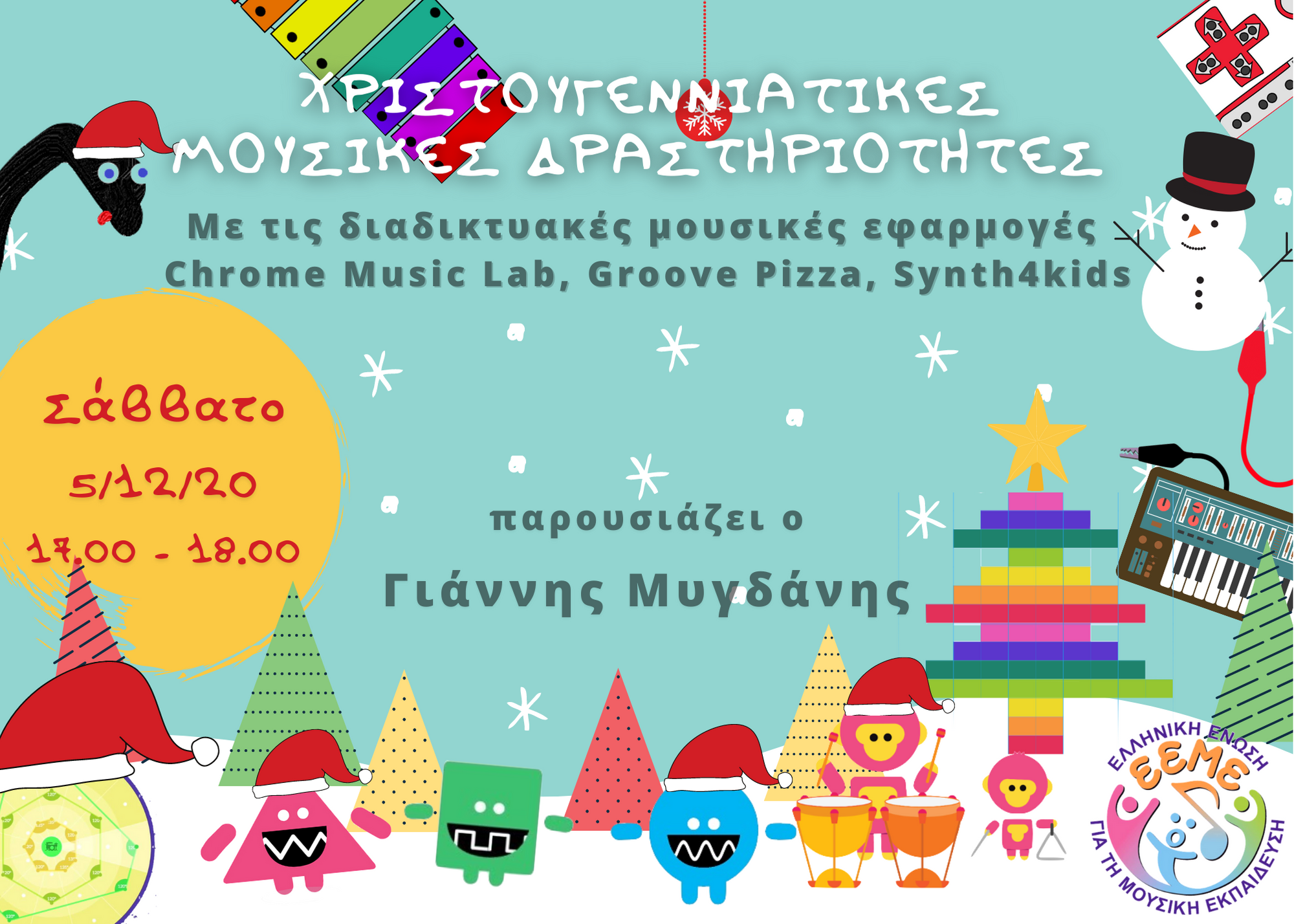
Christmas music activities with the online applications Chrome Music Lab, Groove Pizza, and Synth4kids [In Greek]
Online Seminar in Music Technology5 December 2020Greece
Mygdanis, Y. (2020). Christmas music activities with the online applications Chrome Music Lab, Groove Pizza, and Synth4kids [Seminar, in Greek]. Online Seminar in Music Technology, 5 December 2020, Online.
Mygdanis, Y. (2020, December 5). Christmas music activities with the online applications Chrome Music Lab, Groove Pizza, and Synth4kids [Seminar, in Greek]. Online Seminar in Music Technology, Online.
Abstract
This seminar proposes ways of integrating new technologies and digital applications into distance music teaching and learning while taking into account the particular conditions that have emerged in online education. Using the web-based music applications Chrome Music Lab, Groove Pizza, and Synth4kids, participants develop Christmas-themed music-education activities that teachers can incorporate into their own educational practice.
Using virtual instruments in music lessons: The case of Synth4kids [In Greek]
8th GSME Conference — “Music Education and Society: New Challenges, New Directions”23–25 November 2018Thessaloniki, Greece
Mygdanis, Y. (2018). Using virtual instruments in music lessons: The case of Synth4kids [Conference workshop, in Greek]. 8th GSME Conference — “Music Education and Society: New Challenges, New Directions”, 23–25 November 2018, Thessaloniki, Greece.
Mygdanis, Y. (2018, November 23–25). Using virtual instruments in music lessons: The case of Synth4kids [Conference workshop, in Greek]. 8th GSME Conference — “Music Education and Society: New Challenges, New Directions”, Thessaloniki, Greece.
Abstract
In the contemporary digital era, music educators need to take students’ musical needs and preferences seriously and design learning activities that make purposeful use of technology (Tobias, 2016), since technology continually transforms the ways in which people interact with music. The integration of digital media into music-education activities expands established practices of music teaching and learning, while classrooms that incorporate such media tend to adopt hybrid approaches that can more readily accommodate contemporary methodological practices (Tobias, 2016). Over recent decades, virtual instruments have emerged as a category of applications that graphically represent musical instruments on a screen. Research has shown that integrating virtual instruments into music education can support the development of performance skills, creativity, and accompaniment techniques, as well as deeper understanding of musical genres, harmonic principles, and orchestration (Ho, 2007). Although they offer new possibilities and may contribute to the development of pedagogical models that differ from traditional approaches (Williams, 2014), their educational use often remains confined to music-theory or aural-skills instruction (Ruismäki, 2013). This limitation is particularly evident with younger children, since traditional music-pedagogical approaches such as Dalcroze, Kodály, and Orff were developed many decades ago and do not include music technology as part of their original content. Consequently, they may not fully reflect contemporary children’s musical experiences and preferences and may emphasise musical styles and instruments that are less familiar within today’s digital world (Williams, 2014). With regard to the philosophy underlying music-application design, although digital media offer substantially expanded possibilities, many applications remain oriented towards traditional developmental models based on familiar user expectations and behaviours (Williams, 2014), resulting primarily in screen-based representations of physical instruments such as metallophones, pianos, and guitars. Synth4kids is an original web-based virtual-instrument application designed for children aged four to eight. It is oriented towards analogue sound synthesis and enables children to encounter principles of electronic music from an early age. In practical terms, it functions as a monophonic synthesiser that incorporates elements drawn from traditional music-pedagogical approaches—including colour-sound associations, the pentatonic scale, movable-do principles, and kinaesthetic experiences—facilitating its integration into music-education activities (Mygdanis, 2018). The purpose of this workshop is, first, to provide a concise presentation of the capabilities of Synth4kids and, second, to design and implement music-education activities using the application within a music lesson. The principal pedagogical aims of the activities are to foster children’s creativity through collaborative music teaching and learning, sound exploration and experimentation, and an emphasis on kinaesthetic engagement. For active participation, attendees are asked to bring an electronic device, preferably a tablet or computer with a screen resolution of at least 768 × 1024 and internet access. Notes and graphic scores will also be provided for selected activities.
Guest lectures
Musical games, cables, and sonic experimentation in preschool and early primary music education with Synth4kids software [In Greek]
Public Lectures 2026 — SoScieAtH21 January 2026Nicosia, Cyprus
Mygdanis, Y., & Papazachariou-Christoforou, M. (2026). Musical games, cables, and sonic experimentation in preschool and early primary music education with Synth4kids software [Public lecture, in Greek]. Public Lectures 2026 — SoScieAtH, 21 January 2026, Nicosia, Cyprus.
Mygdanis, Y., & Papazachariou-Christoforou, M. (2026, January 21). Musical games, cables, and sonic experimentation in preschool and early primary music education with Synth4kids software [Public lecture, in Greek]. Public Lectures 2026 — SoScieAtH, Nicosia, Cyprus.

Abstract
This presentation focuses on the possibilities and prospects for using Synth4kids, an original software application designed and developed by Yannis Mygdanis to support music-education activities and STEAM learning scenarios in music pedagogy. Ideas and applications across different educational settings are presented, combining digital media and musical instruments within a framework in which the classroom becomes a music laboratory for creativity, collaboration, and imagination and responds to the demands of the contemporary post-digital context. The content draws on long-term research activity conducted both by the software’s creator and by other researchers across diverse music-learning environments, including early childhood music education, special education, primary school, and conservatoire education.
No results found.
Release information
- Design and development
- Yannis Mygdanis
JamMixLab
Soundscape creation & music production
A music-making and mixing lab with loops and instruments.

SoundRoutes
Soundscape creation & music production
A soundscape creation environment connecting sounds, places and routes.

DJ Ostomachion
Soundscape creation & music production
Educational music software based on Archimedes’ Ostomachion.

VR Forest 3
Extended reality (XR)
A 3D musical world for exploring the pentatonic scale.

Haunted 3D Music Lab
Extended reality (XR)
A haunted music laboratory in 3D and VR.